Mont-Ogenne gas pipeline renewal: HDD crossing beneath the Gave de Pau

Date
Juin – Septembre | 2022

Type of installation
Gas

Pipe
HDPE

Drilling length
2 x 464 m

Soil
Limons, graviers et sables

Location
Mont, Pyrénées-Atlantiques | France
We crossed beneath the Gave de Pau as part of the Mont-Ogenne gas pipeline renewal project in France, a TEREGA gas transmission infrastructure scheme, adapting the design and drilling process to the project's geological and environmental conditions.
The Mont-Ogenne Project forms part of the renewal of the DN650 Mont-Ogenne-Camptort pipeline, known as “Le Lacal”, a gas transmission infrastructure owned by TEREGA. Following the detection of defects in the coating of the existing pipeline, TEREGA proposed the reconstruction of the first 8.7 kilometres of the line, from the Mont compression station to Vielleségure.
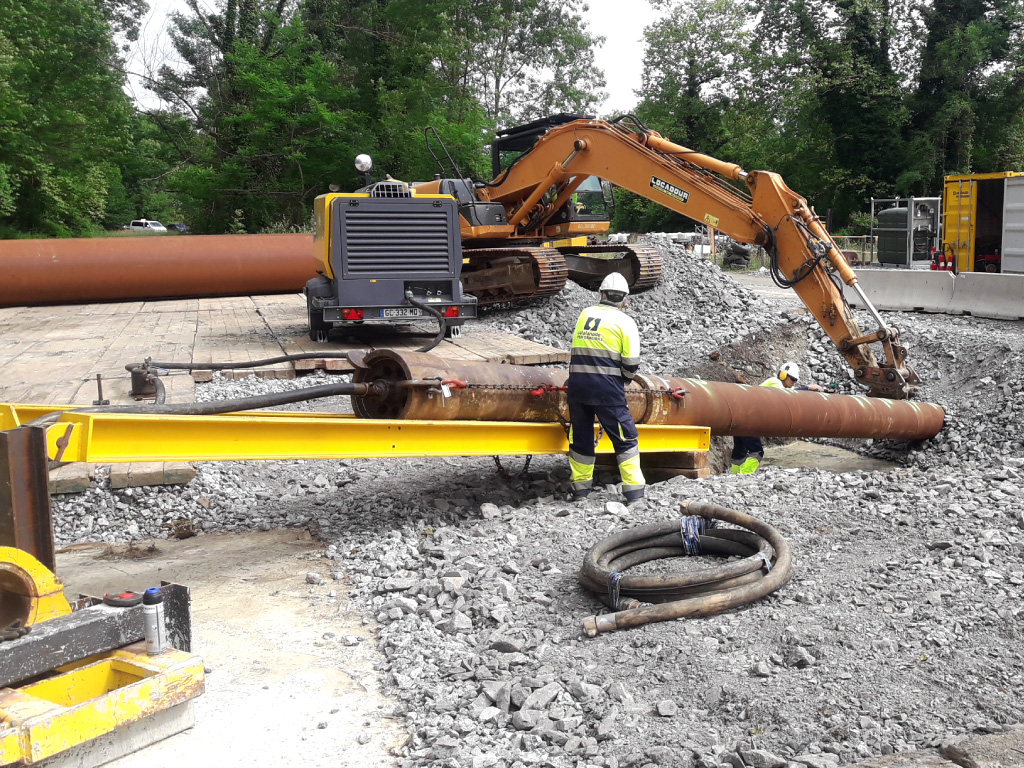
For DENYS, we carried out the Horizontal Directional Drilling (HDD) works required to cross beneath the Gave de Pau, one of the most challenging sections of the route, which required a specifically engineered solution. One of the project’s key features was the crossing of the Gave de Pau River, for which HDD was selected as the preferred installation method.
Two 464-Metre Drillings
During the design phase, we assessed the possibility of carrying out a single drilling operation to install both pipelines. However, this option was ruled out due to its higher cost and the additional risks associated with pullback operations, and we ultimately opted for two independent parallel drillings.
We completed the two HDD drillings, each with a total drilled length of 464 metres.
Drilling works specifications:
🔵 2 HDD drillings of 464 m each: 1 × HDPE Ø160 mm PN16 and 1 × DN650 steel gas transmission pipeline.
📏 Horizontal length: 461 m per drilling.
🎯 Pilot bore: Ø251 mm (9 7/8″).
🔩 HDD casing 1: Ø508 × 10 mm, 32 m long.
🔩 HDD casing 2: Ø1,220 × 19.1 mm, 32 m long.
⚙️ Final diameter for the DN650 pipeline: Ø914.4 mm (36″).
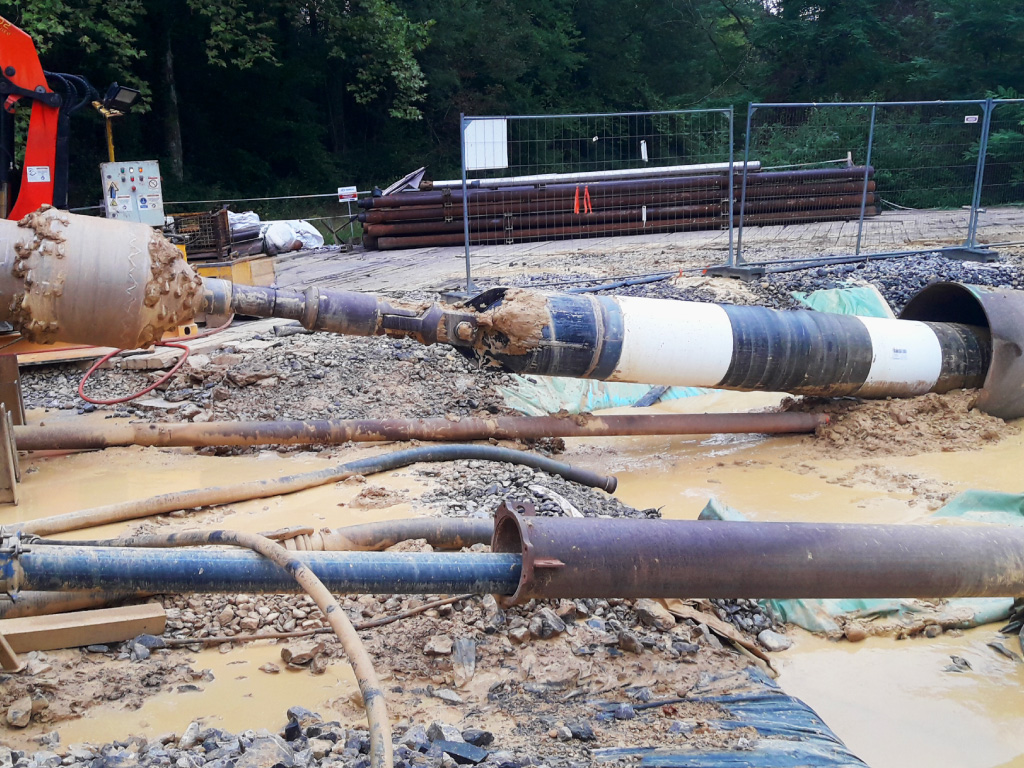
For the drilling intended for the DN650 gas pipeline, we carried out three reaming stages, progressively increasing the bore diameter to Ø508 mm (20″), Ø711.2 mm (28″) and Ø914.4 mm (36″).
Alluvial and Groundwater Conditions: The Project's Main Challenge
Every project presents unique challenges and, in this case, one of the main difficulties was linked to the ground conditions and hydrogeological characteristics of the Gave de Pau area.
Geological investigations identified ground comprising:
🟤 Silts
🪨 Gravels
🟡 Sands
⛰️ Low-permeability tertiary molasse bedrock
💧 Groundwater level: approximately 2 m average depth
These geological and hydrogeological conditions were compounded by the environmental sensitivity of certain sections of the project area, including:
💧 Wetland areas
🌊 Flood-prone zones
⚠️ Contaminated land
Before defining the final drilling alignment, we carried out additional topographical and ground-penetrating radar (GPR) surveys, together with a review of the available geological information, in order to identify existing utilities and gather the information required for construction.
Intersect Methodology: One Drilling Rig on Each Riverbank
To meet the project’s technical specifications, we designed both crossings using the Intersect methodology, working simultaneously from each end of the alignment.
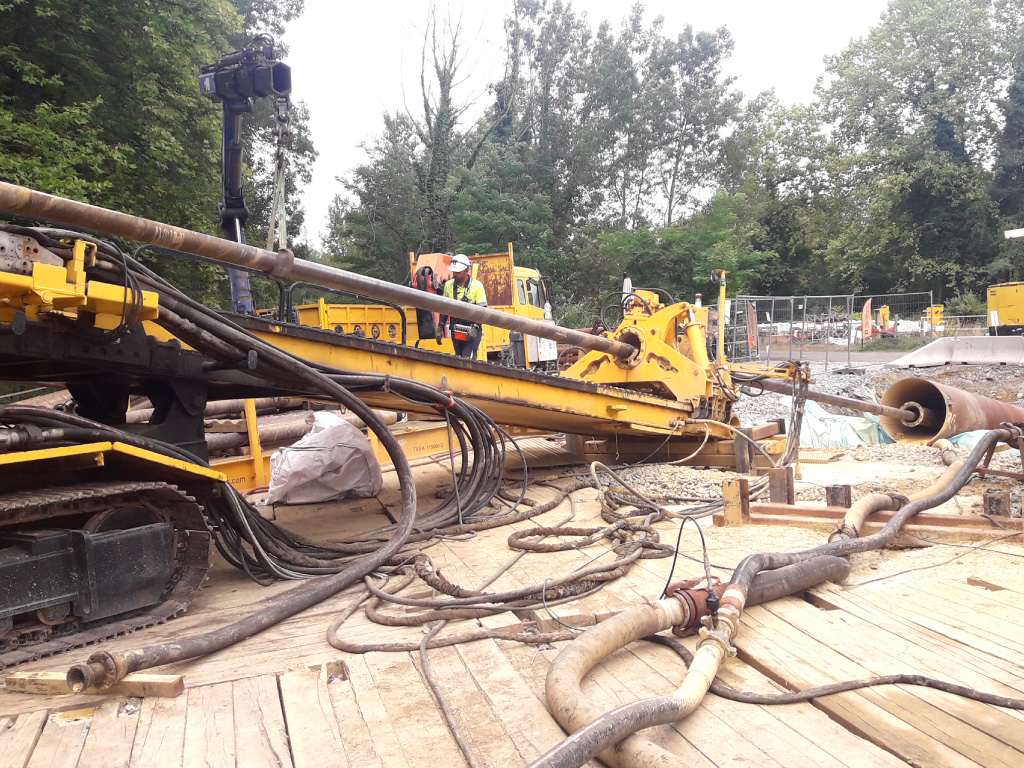
To achieve this, we deployed two drilling rigs, one on each bank of the Gave de Pau:
⚙️ 200-tonne drilling rig, equipped with API 6 5/8″ FH drill pipe.
⚙️ 50-tonne drilling rig, equipped with 4½” IF drill pipe.
Pilot bores were drilled from both ends until reaching a meeting point located in the central section of the alignment. At this stage, the intersection of the two pilot bores was completed by introducing the 8½” drilling head into the 9 7/8″ bore drilled by the 200-tonne rig.
This methodology was applied to both crossings, beginning with the Ø160 mm HDPE conduit and subsequently the DN650 gas pipeline crossing.
The alignment design and the use of the Intersect method enabled us to undertake the Gave de Pau crossing from both banks simultaneously, coordinating the progress of the two rigs while maintaining precise control of the bore path throughout pilot drilling operations.
From Reaming to Pipeline Pullback
Once the pilot bores had been completed using the Intersect methodology, we commenced the reaming operations required to achieve the final diameters specified for each installation. Throughout the process, bentonite-based drilling fluids and recycling systems were used, with dedicated areas established on site for the collection and management of drilling muds and spoil.
For the DN650 gas pipeline crossing, successive reaming passes were carried out until reaching a final bore diameter of Ø914.4 mm (36″). After conditioning and cleaning the borehole, we completed the pullback of the DN650 steel pipeline using the 200-tonne rig.
The installation of the Ø160 mm HDPE conduit was then completed using the 50-tonne rig. As part of the final quality control process, a gyroscope survey was carried out inside the installed pipelines to verify the as-built alignment.
This completed all stages of the process, including pilot drilling, reaming, bore cleaning and pipeline installation, while maintaining control over both the alignment and construction conditions throughout the crossing beneath the Gave de Pau.
HDD for the Renewal of a Strategic Infrastructure Without Direct Intervention in the Riverbed
Selecting the most appropriate trenchless solution is essential to anticipate and overcome the constraints and challenges that may arise throughout a project.
In this case, Horizontal Directional Drilling (HDD) enabled us to address the specific requirements of the Mont-Ogenne gas pipeline renewal through two 464-metre underground crossings beneath the Gave de Pau, avoiding the need for open-cut excavation within the river channel.
This solution allowed us to complete the works while minimising direct intervention in the surrounding environment and adapting the construction methodology to the geological, hydrogeological and environmental constraints present on site.
As a result, we successfully installed the new DN650 gas pipeline and the Ø160 mm HDPE conduit, demonstrating once again how trenchless technologies can deliver technically complex crossings while reducing environmental impact.
Frequently Asked Questions
❓What was the Mont-Ogenne Project?
The project forms part of the renewal of the TEREGA DN650 Mont-Ogenne-Camptort “Le Lacal” gas transmission pipeline in France. Our involvement focused on completing the Gave de Pau crossing using Horizontal Directional Drilling (HDD).
❓How many HDD crossings were completed beneath the Gave de Pau?
We carried out two independent and parallel HDD drillings, each with a developed length of 464 metres and a horizontal length of 461 metres.
❓Which pipelines were installed using HDD?
One crossing was used to install the new DN650 steel gas transmission pipeline, while the second was used to install an Ø160 mm PN16 HDPE conduit.
❓What is the Intersect methodology and how was it used at Mont-Ogenne?
The Intersect methodology allows pilot drilling to be carried out from both ends of the alignment until the bores meet. At Mont-Ogenne, we used a 200-tonne drilling rig and a 50-tonne drilling rig, positioned on opposite banks of the Gave de Pau, to complete the pilot drilling operations.
❓Why was Horizontal Directional Drilling used to cross the Gave de Pau?
Horizontal Directional Drilling (HDD) enabled us to complete two 464-metre underground crossings beneath the Gave de Pau without excavating trenches within the river channel, minimising direct environmental impact and adapting the works to the geological, hydrogeological and environmental conditions of the site.